
Bars are major social and economic contributors
to communities around the world, according to new research conducted by Oxford
Economics. The study, commissioned by AB InBev, examined the economic and
social impact of bars across five global markets — Brazil, Mexico, South Korea,
the United Kingdom, and the United States.
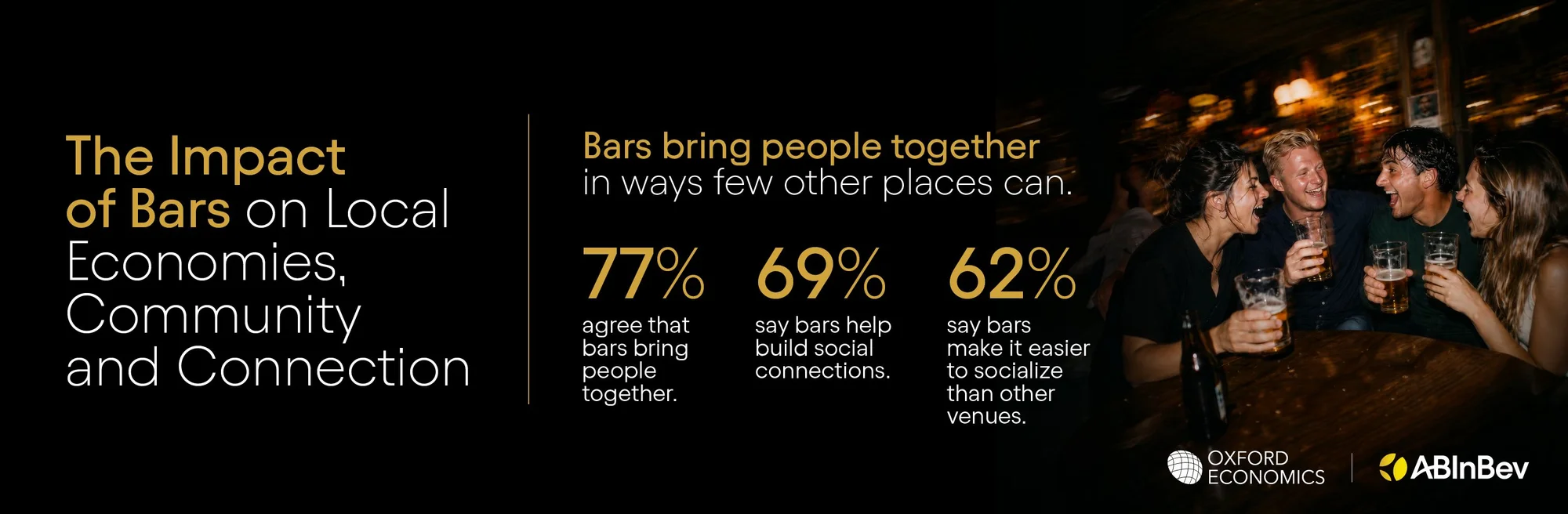
Across the markets surveyed, 77 percent agree
that bars bring people together by creating a shared atmosphere; 72 percent agree
bars make a positive economic contribution to their local economy, and 69
percent say bars help build social connections.[1]
More than six in 10 respondents agree bars are important community assets and that
bars make it easier to socialize than other venues.
The research comes as bars around the world continue
to welcome fans throughout the final week of the FIFA World Cup 2026™, one of many cultural and sporting moments that
bring people together to celebrate at their local bar. Among those surveyed, 51%
said they planned to watch the FIFA World Cup 2026™
at a bar, reinforcing their role as gathering places for shared moments.
“Bars bring people together and beer is at the heart of these moments where memories are made, glasses are raised and friendships are strengthened,” said Michel Doukeris, Chief Executive Officer of AB InBev. “From sporting events – like the NBA Finals, the FIFA World Cup 2026™ and Wimbledon – to celebrations with friends and families, bars are shared assets for communities around the world and need to be supported and protected.”
“This
research adds new data and measurable insight into something many cultures have
long understood through lived experience. Bars are not just businesses. They
are important social institutions that drive human connection and economic
activity within communities,” said Innes McFee, CEO of Oxford Economics.
Across the five markets surveyed, bars support
more than 2 million jobs and contribute approximately $126 billion in gross
value added (GVA). The research also found public backing for bars in their
communities, with more than half of respondents (58 percent) agreeing that it
is important for local governments to do more to support them. That support was
broadly consistent across markets, possibly reflecting a shared view of bars as
contributors to jobs, local economies, and community life[2].
The study further examined how bars serve
different cultural and social roles across markets:
•
Bars are
deeply embedded in social life in Brazil, where 71 percent of respondents said
they visit at least once a month, 60 percent said they typically stay for more
than two hours, and 36 percent said they met a lifelong friend at a bar.
•
In
Mexico, bars are a central place for connection and shared sporting moments,
with 77 percent of respondents saying they expected to watch at least one FIFA World Cup
2026™ match
at a bar. Of those surveyed, 75 percent said they also feel happier after visiting a bar.
•
In South
Korea, bars are a core part of both social and professional life, with
93 percent of respondents saying bars are either the main way they socialize or
a regular part of their social life, and 82 percent indicating that they expected
to watch at least one FIFA World Cup 2026™
match at a bar.
•
In the
United Kingdom, 80 percent of Britons surveyed agree local pubs and bars are an important shared
community asset and 74
percent agree that it is important that local governments support them, the
highest level among all five markets surveyed.
•
In the
U.S., 74 percent of respondents agree that bars create a shared atmosphere that
brings people closer together, and 69 percent agree that bars make a positive
economic contribution to their local economy.
The full Oxford Economics report provides
additional detail on the economic and social role of bars across the five
markets surveyed. Read the full report here.
All survey figures, unless otherwise stated,
are from YouGov Plc. Total sample size was 5,311 drinking age adults, who have
visited a pub or bar in the last 12 months. Fieldwork was undertaken between
16th - 28th April 2026. The survey was carried out online.
[1] Throughout, ‘agree’ refers to the sum of respondents either strongly
agreeing or agreeing with the statement.
[2] The share of respondents agreeing or strongly agreeing
that “It is important that local government support pubs and bars” was 74% in
the UK, 68% in Brazil, 57% in Mexico, 50% in the US, and 39% in South Korea.

